
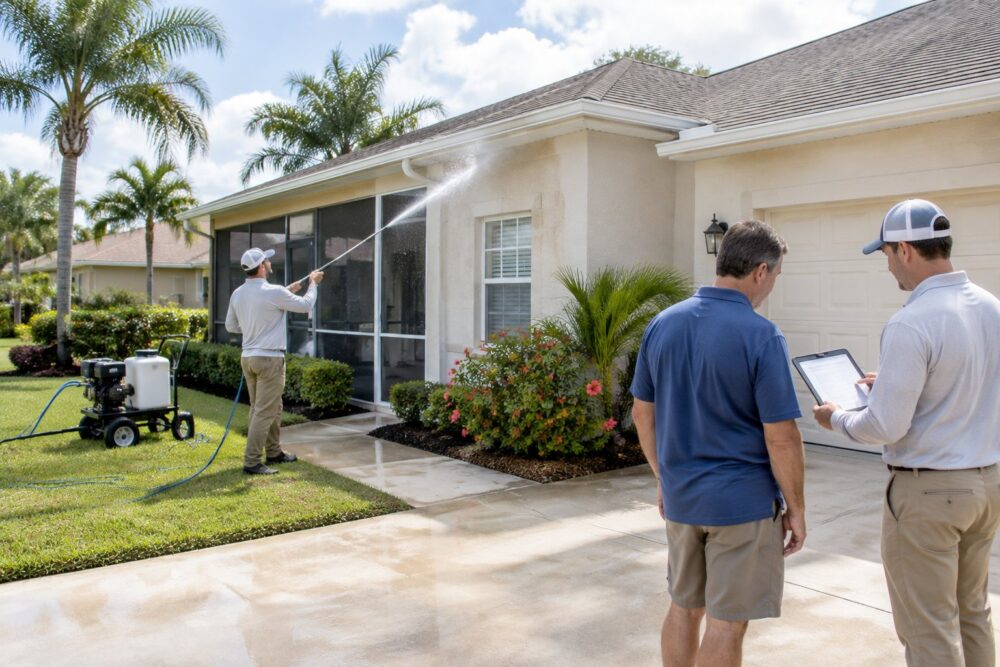
House Washing Prices in Central Florida: What Shapes Your Quote in 2026
Your stucco looked bright two summers ago. Now the north side has a green film, the soffits are gray, and pollen has settled into every ledge of trim. House washing prices in Central Florida come down to four things. They are the size of your home, the siding material, how much mold and mildew has built up, and the cleaning method your surface needs. A small, single-story home with light grime costs less to wash than a large two-story home with heavy algae on shaded walls.
Central Florida humidity makes this a yearly question for many homeowners in Orlando, Clermont, and Minneola. Afternoon storms keep walls damp, and shaded walls grow mildew fast. Essentials Pressure Washing has washed homes here since 2005. The crew knows which walls turn green first and how long the cleaning solution needs to work on them.
In this guide, you’ll learn how home size, siding type, and buildup shape the cost of pressure washing or soft washing a house. This guide explains the factors behind a quote, since your actual price needs an estimate for your specific property. You’ll also see how quotes are built and what to ask before you hire. By the end, you’ll be able to compare two quotes line by line and tell which one covers more of your home.
How Do House Washing Prices Change with Home Size?
Bigger homes cost more to wash because they have more wall area, more trim, and more soffit to clean and rinse. Size sets the starting point for most quotes. The other factors then move the price up or down from there.
When you look up the average pressure washing cost for a house, you’ll see wide ranges. That’s because square footage alone leaves out height, wall layout, and how dirty the surface is. Two homes of the same size can have very different quotes.
What Changes Between a 1,500 and 2,500 Square Foot Home?
A 2,500 square foot home has more exterior wall to cover, so the crew uses more cleaning solution and more rinse time. Here’s what grows as your home gets larger:
- Wall area: More siding or stucco needs solution applied and rinsed top to bottom.
- Soffits and fascia: Longer rooflines mean more overhang to clean, where cobwebs and wasp nests collect.
- Gutter faces and trim: More linear feet of trim around windows, doors, and gutters.
- Landscaping: Larger homes tend to have more beds along the walls, and each one gets rinsed before and after.
Your home’s living space is a rough guide, not an exact one. A 1,500 square foot home with a screened lanai and lots of corners can take as long as a plain, boxy 2,000 square foot home.
Why Does a Second Story Affect the Quote?
A second story adds height, and height adds time. The crew has to reach the upper walls, soffits, and gutter faces while keeping the solution even so it doesn’t streak as it runs down.
Taller walls also need more care on the rinse. Solution that dries on upper stucco or siding can leave marks, so the crew works in sections and watches the sun and wind. Ladder work around a second story also takes longer than walking a single-story wall. Once you know how size and height play in, the next step is seeing how providers turn those details into a price.
How Is a House Wash Priced?
Most house washes are priced as a flat quote after someone looks at your home, though some providers start from a per square foot rate. The method behind the number tells you a lot about what the crew is paying attention to.
Per Square Foot vs. a Flat Quote
A pressure washing cost per square foot is easy to understand. You multiply your home’s size by a rate and get a number. The problem is that it treats every square foot the same, whether it’s a sunny wall or a shaded one covered in green growth.
A flat quote, or pressure washing estimate, is built from a walk-around or a photo review of your home. The crew looks at siding type, height, buildup, and access, then gives one price for the whole job. You know the total up front, and the price reflects your home’s real condition.
If a quote is per square foot, ask which square footage they use. Living space, wall area, and lot size give very different numbers.
When Does a Minimum Service Fee Matter?
A minimum service fee is the lowest price a company will charge for any job. It covers drive time, setup, and the equipment it takes to show up at all. It matters most when your job is small.
If you only need one wall cleaned, the minimum may be the price you pay. Adding a second item, like your driveway or walkway, often uses the same trip and setup. That makes a combined estimate worth asking about.
Are Hourly Rates Useful for Comparing Quotes?
Pressure washing prices per hour are hard to compare because you don’t know how long the pressure washing will take. A crew with a lower rate may take longer. A crew with a higher rate may finish faster with better equipment.
Pressure washing cost per hour is more useful for small add-ons than for a full house wash. For the main job, ask for a total price that lists what’s included. With pricing styles covered, it’s time to look at what makes one home harder to clean than another.
What Makes One Home Cost More to Clean?
Siding material, the amount of buildup, and how easy your home is to work around all push the pressure washing cost up or down. These details explain why your neighbor’s quote may not match yours.
Here is how each factor tends to move an estimate:
| Quote factor | What the crew looks at | Effect on your estimate |
|---|---|---|
| Home size | Wall area, soffits, fascia, and trim | More surface means more solution and rinse time |
| Stories | Upper walls, soffits, and gutter faces | Added height adds time and care |
| Siding type | Vinyl, stucco, brick, or painted block | Rough or porous surfaces often need longer contact time |
| Buildup | Pollen, mildew, or thick algae on shaded walls | Heavy growth needs more solution and treatment time |
| Access | Side yards, fences, pool cages, and plant beds | Tight or crowded areas slow the work |
| Driveway add-on | Oil spots, tire marks, or green film on concrete | Can be included in a combined estimate |
Siding, Stucco, Brick, and Painted Block
Each surface holds dirt in its own way, and each needs care:
- Vinyl siding: Smooth and quick to rinse, but water forced behind the panels can cause problems, so it gets low pressure.
- Stucco: Rough texture traps mildew in tiny pockets. High pressure can etch or chip it.
- Brick: Porous brick and mortar joints hold algae and dirt. Older mortar can wash out under strong pressure.
- Painted block: Common on older Florida homes. Too much pressure can lift or peel the paint.
Rough or porous surfaces like stucco and brick tend to need more solution and longer contact time. That adds to the job.
Mold, Mildew, Algae, and Stain Buildup
Light pollen and dust come off fast. Heavy black mildew or thick green algae on a north-facing wall takes more solution and more time to break down. In Orlando, the walls that never get direct sun turn green first.
The longer growth sits, the deeper it settles into the surface. A home washed about once a year may need less treatment each time than one left for several years. Some stains, like rust from irrigation or old water marks, may fade without fully coming out. It depends on how long they’ve been there and the surface underneath.
Access, Landscaping, and Areas That Must Stay Dry
Tight side yards, fences close to walls, and pool cages slow the crew down. So do dense shrubs and flower beds along the foundation. Plants get rinsed before and after so nothing sits in cleaning solution.
Before the wash starts, the crew should check for damaged areas and anything that needs to stay dry. That includes outdoor outlets, light fixtures, cracked stucco, and gaps around windows. Extra prep for these spots adds a little time. The method used on your walls also plays a role, which comes next.
Does the Cleaning Method Affect the Quote?
Yes. The method changes the equipment, the amount of solution, and the time spent on each surface. The soft washing cost for a house reflects the solution and care it takes. The cleaning solution does the work, so the crew needs much less pressure.
Why House Exteriors Usually Need a Soft Wash
Soft washing uses low pressure and a cleaning solution that breaks down mold, mildew, and algae. The solution sits on the surface for a short time, then gets rinsed away top to bottom. It breaks down the growth instead of just blasting the surface, which can help the wall stay clean longer.
High pressure on a house can force water behind siding and etch stucco. It can also leave stripe marks where the wand moved too close. Soft washing protects siding, stucco, brick, and painted block while still lifting the grime.
Why Concrete and Pavers Need Different Care
Concrete driveways can handle more pressure than a house wall. Pressure washing at the right setting clears oil spots, tire marks, and black algae from the surface and the expansion joints. A good crew cleans in even passes so you don’t end up with stripes.
Pavers need lower pressure so the joint sand stays in place. Stamped concrete and brick pavers also get a gentler setting. So when you weigh pressure washing vs. soft washing, think of it as matching the method to each surface. A quote that covers both your house and driveway should use two methods, one for each.
How Can You Compare House Washing Quotes?
Compare quotes by checking what surfaces are covered, how stains and delicate areas will be handled, and whether extra areas are included. A lower price often means fewer items on the list.
Check Which Exterior Surfaces Are Included
A full exterior house washing visit should cover siding, soffits, fascia, gutter faces, and trim. Some pressure washing services quote only the walls and charge extra for the rest. Ask each provider to list every surface in writing.
If you’re in Lake County, you can see what a full wash looks like on this Minneola house washing page.
Ask How Stains and Delicate Areas Will Be Handled
Ask these questions before you agree to a price:
- What pressure will you use on my siding or stucco?
- How will you treat heavy mildew on shaded walls?
- What will you do to protect my plants and flower beds?
- Which areas will you keep dry, like outlets and light fixtures?
- What stains might not fully come out?
An honest crew will tell you up front if a rust stain or old water mark may only fade. On heavily shaded walls, extra treatment time works better than extra pressure. That answer is a good sign the crew knows the surface.
Compare a House-Only Quote with a House-and-Driveway Quote
If your driveway also has oil spots or green film, ask for both a house-only quote and a combined quote. Seeing both side by side shows you what each part of the job covers.
Check that the driveway part of the quote names your surface and the stains on it. Rust removal depends on how long the stain has been there, so expect that detail in the quote.
Getting a Price That Fits Your Home
The price that fits your home comes from a quote built on your siding, your height, and the buildup on your walls. A per square foot guess can’t see the green film on your north wall. A walk-around or a few photos can.
Essentials Pressure Washing has cleaned homes across Central Florida since 2005. The family-run crew uses a soft wash on siding and stucco and the right pressure on concrete. Quotes are free with no obligation, and you may get a call or text back the same day.
Send your address and tell us what needs cleaning. You can call or text (407) 284-9438 any day from 7:30 a.m. to 7:30 p.m. to get your free estimate.
Frequently Asked Questions
Can I Estimate a House Wash from My Home’s Square Footage?
Square footage gives you a rough starting point, but it won’t give you an exact price. Height, siding type, and mold buildup all change the final number. A quick photo review or walk-around gives you a real figure.
Does Soft Washing Cost More Than Pressure Washing?
Soft washing uses cleaning solution, so the materials can cost a little more than plain water pressure. It’s the safer method for siding and stucco, and it breaks down mildew instead of just blasting it. That can help your walls stay clean longer between washes.
What Does a Professional House Wash Include?
A professional house wash covers siding, soffits, fascia, gutter faces, and trim. Cobwebs and wasp nests come down in the same pass. Landscaping gets rinsed before and after so plants don’t sit in solution.
Will Heavy Mold or Mildew Raise the Price?
Yes, heavy mold or mildew takes more solution and more treatment time. Shaded, north-facing walls are the usual trouble spots in Central Florida. Washing about once a year keeps buildup lighter and the cost easier to plan for.
Can I Get One Quote for My House and Driveway?
Yes, you can ask for a combined estimate that covers house washing and driveway cleaning. Tell the crew about both when you ask for a quote.